

AI Dashcams for Fleets: DC10 vs DC20 Explained | TEQ District
Let’s be honest about something that most dashcam sellers will not tell you.
A standard dashcam — the kind mounted on millions of windscreens across the country — does one thing really well. It records. It captures everything: the speed, the angle, the moment of impact, the chaos immediately after. The footage is timestamped. The resolution is decent. And when you need to prove what happened, it is right there on a memory card.
That is valuable. We are not dismissing it.
But here is the thing. While your dashcam was recording that accident — it was not preventing it. It watched the whole thing happen and did not say a word.
An AI dashcam does something different. When it detects that your driver is following too closely at motorway speed, it alerts them. When it notices the driver’s eyes closing — not closed, just starting to close — it fires an in-cab warning. When the vehicle begins to drift out of its lane without indicating, it intervenes. Not after the fact. While there is still time.
That is the real difference between a recording device and an AI dashcam. One is a witness. The other is a guardian.
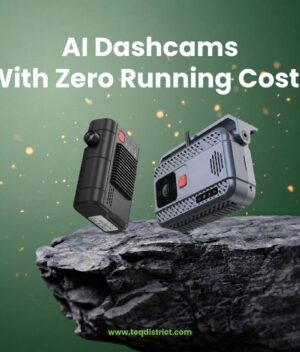
At TEQ District, we supply two AI dashcam models — the DC10 and the DC20. They share the same AI intelligence platform. They serve slightly different fleet needs. And they both do something no ordinary dashcam can: they work to prevent accidents instead of simply documenting them.
“A dashcam that only records is like a security guard who watches a robbery, writes it down in a logbook, and does nothing to stop it.”
First, What Is AI Actually Doing in These Cameras?
When we say “AI dashcam,” we mean a camera with a built-in computer — a Neural Processing Unit (NPU) — that is continuously analysing what it sees and making decisions in real time. It is not sending footage to a cloud somewhere and waiting for a human to review it. The AI runs on the device, in the vehicle, while the vehicle is moving.
Both the DC10 and DC20 carry the same set of AI features. Here is what they each do:
- FCW (Forward Collision Warning): You are getting too close to the vehicle ahead at speed. Alert fires.
- HMW (Headway Monitoring): Your following distance is dangerously short. Continuous monitoring.
- PCW (Pedestrian Detection): A person or cyclist has entered your vehicle’s path. Alert fires.
- LDW (Lane Departure): The vehicle is drifting from its lane without the indicator on. Alert fires.
- DMS — Eyes (Fatigue detection): The AI reads eyelid patterns and detects drowsiness before it becomes dangerous.
- DMS — Yawning (Pre-fatigue warning): Repeated yawning is flagged. Driver prompted to rest.
- DMS — Distraction (Inattention): Driver looking away from the road too long. In-cab alert fires.
- DMS — Phone (Phone use): Device detected near the driver’s face while moving. Event logged.
- DMS — Seatbelt (Belt compliance): Seatbelt not worn. Detected visually.
- Face ID (Driver identity): The camera can verify who is driving, using facial recognition.
- Camera Covered (Tamper detection): If someone covers the lens deliberately, you are immediately notified.
- Smoking Alert (HR compliance): Smoking detected in the cab. Logged as part of the driver record.
Every single one of these features is included free for life after purchase. No monthly subscription. No AI add-on package. You buy the camera, you get all of this, permanently.
Meet the DC10: The Intelligent Starting Point
The DC10 is the entry-level camera in this range — but it is a serious piece of fleet hardware. It is designed specifically for commercial freight fleets.
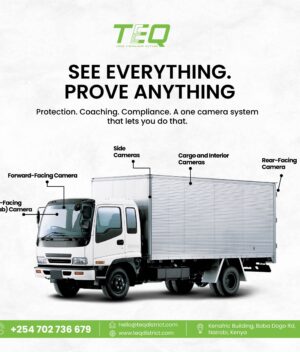
The camera faces forward. It runs the full ADAS suite. It has starlight night vision at 0.01 lux, which means it captures full-colour, clear footage in conditions where most cameras produce a dark, grainy, unusable blur. When you are ready to add driver monitoring, you connect an external driver-facing camera.
DC10 Key Features:
- Forward-facing AI camera built in.
- Expandable to 3 channels total.
- 4G LTE — Global connectivity.
- Built-in GPS.
- Supercapacitor backup (no battery failure).
- Up to 512GB microSD storage.
Meet the DC20: The Flagship, Built for Freight
The DC20 is what you choose when you need everything, in one device, without complexity.
The defining feature is the integrated dual-lens. Unlike the DC10, the DC20 has both lenses built into the same compact unit. One installation. Road-facing camera and cabin-facing camera run simultaneously, with AI active on both, from day one.
DC20 Key Features:
- Road AND cabin lenses built into one unit.
- Full ADAS + full DMS standard from day one.
- Expandable to 6 channels.
- Thermally optimised for high-temperature environments.
- Simpler install — less wiring than separate cameras.
DC10 vs DC20: Which One Is Right for Your Fleet?
| Feature | DC10 | DC20 |
| Built-in lenses | Forward-facing only | Forward + Cabin (dual-lens) |
| DMS | Optional (add external camera) | Built-in (standard) |
| Max Channels | 3 | 6 |
| Night Vision | Starlight 0.01 lux | Ultra-low-light |
| Best For | Fleets new to AI/ADAS priority | Freight, long-haul, full coverage |
A practical way to think about it: Choose the DC10 if you want to start with road-facing AI and expand when ready. Choose the DC20 if you need road and driver monitoring simultaneously from the moment it is installed.
The One Thing That Changes the Entire Conversation
In an industry where most AI dashcam providers charge a monthly subscription to access AI features, the fact that TEQ District’s AI is free for life after purchase deserves its own mention. This is not a promotional offer; it is how the product works. You purchase the camera, and all the AI features—from fatigue detection to lane departure warnings—are yours to use indefinitely.